In an example of aviation-funded green infrastructure, Bologna’s Guglielmo Marconi Airport is financing new cycling tracks and ecological restoration projects. The initiative is part of a legally binding Territorial Implementation Agreement for the Decarbonisation of Marconi Airport, known as the D-Air project, which mandates environmental compensation for the airport’s expansion impacts. The agreement was signed under the coordination of the Metropolitan City of Bologna.
“This agreement demonstrates how strategic cooperation between regional institutions and the airport operator can deliver high-impact environmental and mobility projects,” says Catia Chiusaroli, Head of the Mobility Planning Office at the Metropolitan City of Bologna, a member of ECF's Cities and Regions for Cyclists network. “Through integrated planning and a shared, forward-looking vision for the area, we are promoting sustainable mobility options while ensuring environmental resilience for the area.”
The agreement, first signed in 2015 and updated in 2020, involves the Emilia-Romagna Region, the Metropolitan City of Bologna, the Municipalities of Bologna and Calderara di Reno, TPER (the regional public transport company), SRM (the mobility agency), and Bologna Airport (AdB/SAB). It sets out a framework for environmental mitigation and compensation projects linked to the 2009–2023 Airport Masterplan.
Up to €9.3 Million for Environmental Offsets
Bologna Airport has committed to funding these compensation measures with a budget of €6.5 million, extendable up to €9.3 million, fully sourced from the airport operator’s resources. These funds are allocated explicitly for environmental compensation actions: projects not strictly tied to construction impacts but designed to offset the broader environmental footprint of airport operations, especially as passenger traffic approaches 10 million annually.
The agreement outlines 13 distinct actions, with a focus on reducing CO₂ emissions, enhancing sustainable mobility, and sequestering carbon through the creation of new green areas. These actions are embedded within the broader framework of territorial governance established by the metropolitan area’s spatial planning instruments.
For example, action 1 plans for 36 hectares of the total area to be designed as wooded area, while about 3 hectares will become grassy clearings, sown with a mix of plants to support pollinating insects, to recreate a patch of a fully functioning forest ecosystem in which the querco-carpineto—a typical woodland of the Po Valley—can become a hospitable environment for wildlife, thus also giving new life to the nearby environmental oases of Golene del Lippo and San Vitale, both part of the ‘Natura 2000’ network along the Reno River.
Action 2: EuroVelo 7 Cycle Route and Local Connections
A second major initiative focuses on cycling infrastructure along the Wooded Area and the Reno River, integrating the airport into EuroVelo 7 - Sun Route (EV7), a trans-European cycling corridor. This initiative also aims to fill the gap in the current EV7 cycle path network to Bologna while improving sustainable accessibility to the airport.
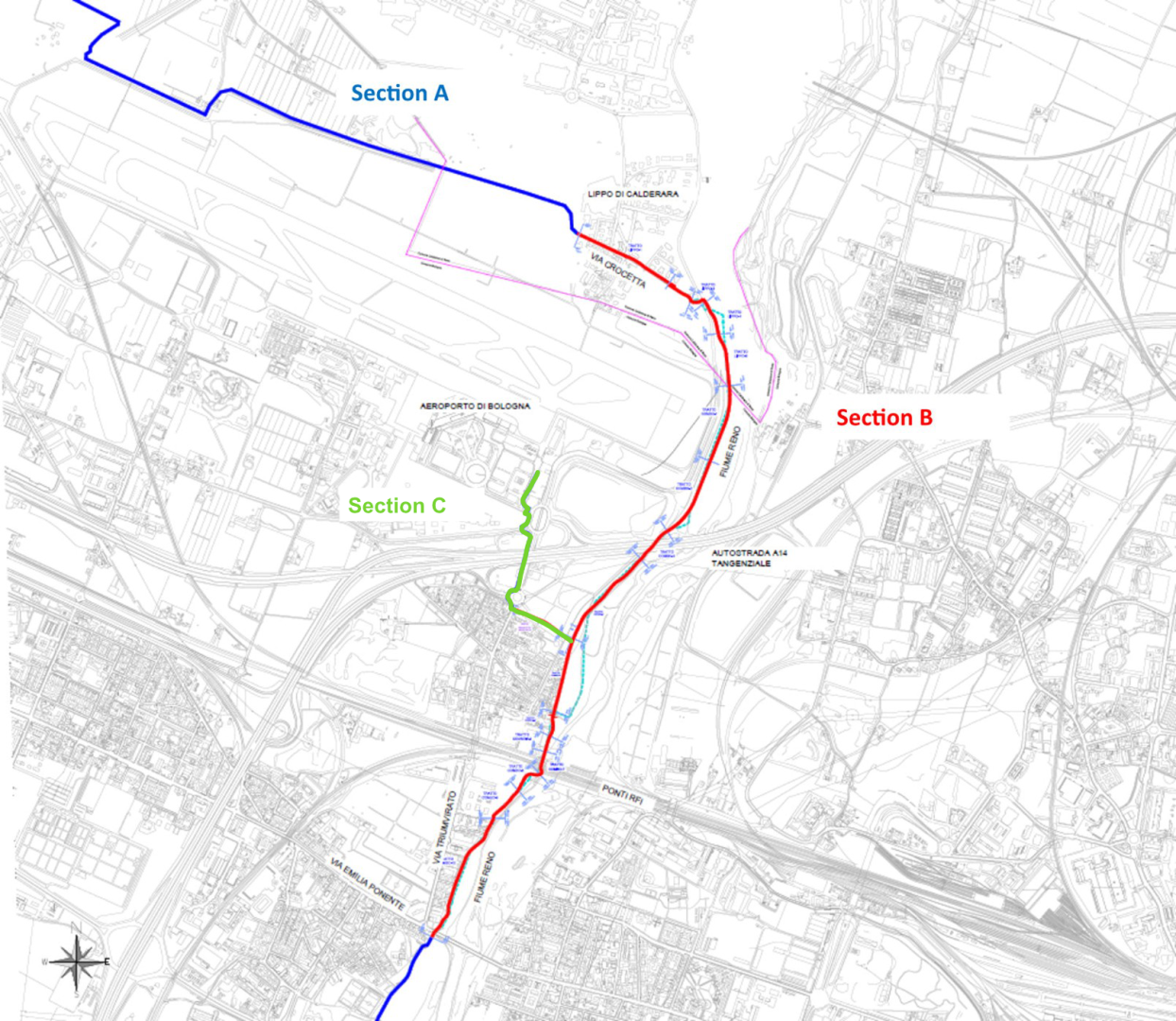
This action consists of three functional segments:
Section A is being implemented by the airport operator, which is responsible for full funding and execution, and will be delivered by the first months of 2026. Sections B and C are fully funded by the airport but will be realised by the Metropolitan City of Bologna. The executive project is scheduled for delivery in 2026. Design responsibilities are shared between the Municipality of Bologna, the Municipality of Calderara di Reno, the Metropolitan City of Bologna, and the Emilia-Romagna Region, while the airport operator (SAB) is funding the construction. Cycle parking is to be installed within airport grounds as part of a separate but related measure.
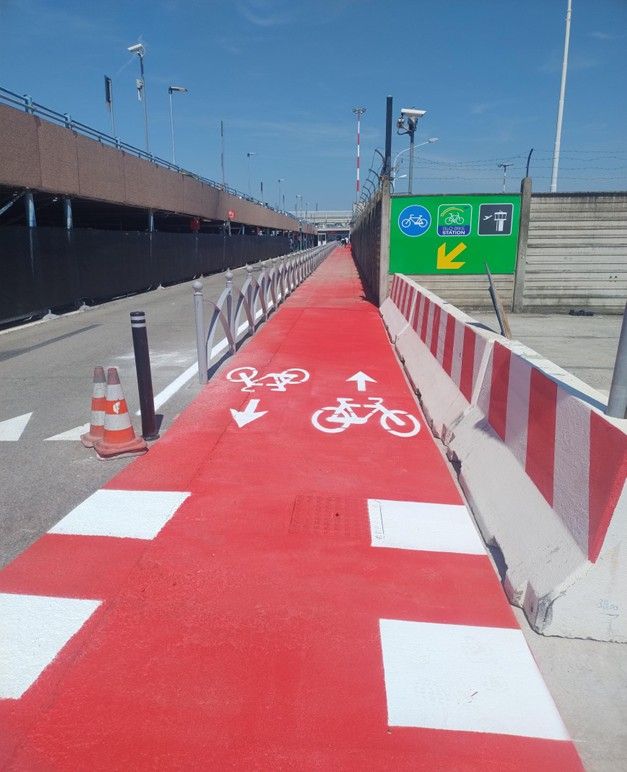
“The airport has meanwhile created internal cycling tracks and a bike station open to passengers and employees. It also obtained FIAB "bike-friendly airport" certification – gold level. The goal is to become the first European airport directly connected to an international EuroVelo route and thus contribute to Bologna's image as a sustainable destination by promoting an eco-conscious tourism model,” says Barbara Melotti, Mobility Manager at Bologna Airport, which is a certified Cycle-Friendly Employer (a certification by ECF, implemented in Italy by FIAB). “The airport is working closely with local authorities to provide a network of cycling services and infrastructures to its catchment area of approximately 10 million passengers and approximately 5,000 employees, improving accessibility and promoting sustainable transportation. When synergy between companies and local authorities occurs, it is an extraordinary opportunity to accelerate the adoption of new solutions for sustainable urban travel.”

A Case Study in Integrated Infrastructure Planning
“The decarbonisation agreement at Bologna Airport is an example of using investments in cycling infrastructure as an environmental compensation measure,” says Aleksander Buczyński, ECF Senior Policy Officer. “The new cycle tracks will benefit the inhabitants of the area, long-distance cycle- tourists, but also employees of the airport and businesses around it. As we pointed out during the discussion on the revision of the TEN-T regulation, major airports are also concentrations of workplaces, and people working there deserve an option to commute in a healthy and sustainable manner.”
By linking airport development with targeted investments in sustainable mobility and CO₂ mitigation, the agreement ensures that local environmental impacts are addressed through concrete, territorially grounded actions, setting a replicable model for other transport hubs across Europe.
“This agreement demonstrates how strategic cooperation between regional institutions and the airport operator can deliver high-impact environmental and mobility projects,” says Catia Chiusaroli, Head of the Mobility Planning Office at the Metropolitan City of Bologna, a member of ECF's Cities and Regions for Cyclists network. “Through integrated planning and a shared, forward-looking vision for the area, we are promoting sustainable mobility options while ensuring environmental resilience for the area.”
The agreement, first signed in 2015 and updated in 2020, involves the Emilia-Romagna Region, the Metropolitan City of Bologna, the Municipalities of Bologna and Calderara di Reno, TPER (the regional public transport company), SRM (the mobility agency), and Bologna Airport (AdB/SAB). It sets out a framework for environmental mitigation and compensation projects linked to the 2009–2023 Airport Masterplan.
Up to €9.3 Million for Environmental Offsets
Bologna Airport has committed to funding these compensation measures with a budget of €6.5 million, extendable up to €9.3 million, fully sourced from the airport operator’s resources. These funds are allocated explicitly for environmental compensation actions: projects not strictly tied to construction impacts but designed to offset the broader environmental footprint of airport operations, especially as passenger traffic approaches 10 million annually.
The agreement outlines 13 distinct actions, with a focus on reducing CO₂ emissions, enhancing sustainable mobility, and sequestering carbon through the creation of new green areas. These actions are embedded within the broader framework of territorial governance established by the metropolitan area’s spatial planning instruments.
For example, action 1 plans for 36 hectares of the total area to be designed as wooded area, while about 3 hectares will become grassy clearings, sown with a mix of plants to support pollinating insects, to recreate a patch of a fully functioning forest ecosystem in which the querco-carpineto—a typical woodland of the Po Valley—can become a hospitable environment for wildlife, thus also giving new life to the nearby environmental oases of Golene del Lippo and San Vitale, both part of the ‘Natura 2000’ network along the Reno River.
Action 2: EuroVelo 7 Cycle Route and Local Connections
A second major initiative focuses on cycling infrastructure along the Wooded Area and the Reno River, integrating the airport into EuroVelo 7 - Sun Route (EV7), a trans-European cycling corridor. This initiative also aims to fill the gap in the current EV7 cycle path network to Bologna while improving sustainable accessibility to the airport.
This action consists of three functional segments:
- A first section along the Wooden Area (Section A) provides the missing tourist and cycling connection of EV7 to the City of Bologna, as well as a sustainable and direct transport link between the SFM Calderara-Bargellino railway station and the nearby urban areas of Lippo di Calderara and San Vitale di Reno — small towns north of the airport, with a predominantly residential and logistics character.
- A second section (B) links Via Emilia Ponente to Lippo di Calderara along the Reno River
- A third segment (Section C) connects the airport to the EuroVelo 7 cycling tourism route by means of a direct branch, and, moreover, to Lippo and Bologna’s city centre, which will serve both cycle tourists and airport employees.
Section A is being implemented by the airport operator, which is responsible for full funding and execution, and will be delivered by the first months of 2026. Sections B and C are fully funded by the airport but will be realised by the Metropolitan City of Bologna. The executive project is scheduled for delivery in 2026. Design responsibilities are shared between the Municipality of Bologna, the Municipality of Calderara di Reno, the Metropolitan City of Bologna, and the Emilia-Romagna Region, while the airport operator (SAB) is funding the construction. Cycle parking is to be installed within airport grounds as part of a separate but related measure.
Section A: cycle track through the wooded area, Section B: Airport-Bologna connection along the Reno River, and Section C: direct branch connecting the airport with EuroVelo7
“The airport has meanwhile created internal cycling tracks and a bike station open to passengers and employees. It also obtained FIAB "bike-friendly airport" certification – gold level. The goal is to become the first European airport directly connected to an international EuroVelo route and thus contribute to Bologna's image as a sustainable destination by promoting an eco-conscious tourism model,” says Barbara Melotti, Mobility Manager at Bologna Airport, which is a certified Cycle-Friendly Employer (a certification by ECF, implemented in Italy by FIAB). “The airport is working closely with local authorities to provide a network of cycling services and infrastructures to its catchment area of approximately 10 million passengers and approximately 5,000 employees, improving accessibility and promoting sustainable transportation. When synergy between companies and local authorities occurs, it is an extraordinary opportunity to accelerate the adoption of new solutions for sustainable urban travel.”
A Case Study in Integrated Infrastructure Planning
“The decarbonisation agreement at Bologna Airport is an example of using investments in cycling infrastructure as an environmental compensation measure,” says Aleksander Buczyński, ECF Senior Policy Officer. “The new cycle tracks will benefit the inhabitants of the area, long-distance cycle- tourists, but also employees of the airport and businesses around it. As we pointed out during the discussion on the revision of the TEN-T regulation, major airports are also concentrations of workplaces, and people working there deserve an option to commute in a healthy and sustainable manner.”
By linking airport development with targeted investments in sustainable mobility and CO₂ mitigation, the agreement ensures that local environmental impacts are addressed through concrete, territorially grounded actions, setting a replicable model for other transport hubs across Europe.


