In 2025, the European Cyclists’ Federation (ECF) entered a period of transition, a good time to reflect on both the progress achieved and the challenges ahead. Jill Warren’s tenure concluded with several important milestones, most notably the adoption of the EU Declaration on Cycling – the historic milestone which cements the central role of cycling for European mobility and which paves the way for improvement at local, regional and national levels.
Since September, Laurianne Krid has led the organisation into its next chapter, with 2025 highlighting several important developments across ECF’s advocacy, research, and collaboration efforts.
In 2025, ECF consolidated and extended its cooperation across the European mobility ecosystem, including renewing the partnership with EIT Urban Mobility, which will focus on shared intelligence and data, joint European projects, and practical tools that support active mobility.
Cities and regions remained at the heart of ECF’s work. Through close collaboration with POLIS, ICLEI Europe, Eurocities and Energy Cities, and via ECF’s Cities & Regions for Cyclists network, the organisation ensured that local and regional experience fed directly into EU policy debates. This included joint advocacy on the EU Social Climate Fund, where ECF championed cycling’s inclusion and positioned it as a practical tool to tackle transport poverty within an €87 billion programme for 2026–2032, aligned with EU guidance on safe infrastructure, access to bikes and multimodal links.
In parallel, we advanced discussions to renew our cooperation with UITP, reinforcing the integration of cycling and public transport in planning, funding and implementation—a building block of a people-centred, low-carbon mobility system. This month, the Confederation of the European Bicycle Industry (CONEBI) and Cycling Industries Europe (CIE), announced a successful merger to become European Cycling Industries (ECI). ECF warmly welcomed this merger, which establishes one consolidated voice for the cycling sector to advocate effectively for competitive industrial policy and market development.
Strong ties with ECI leadership and members will allow more synergies in the future. A joint workshop between ECF and ECI members is also planned before our next AGM.
The adoption of the European Declaration on Cycling, which recognised cycling as a strategic EU priority, was an El Dorado moment for our sector. It represented the culmination of years of tireless campaigning on the part of ECF and our partners. In October, the European Commission published its first progress report, a check-in on the implementation of the European Declaration on Cycling.
The report confirmed growing momentum, but also the challenge of turning political commitments into delivery. ECF welcomed tangible progress, including €3.21 billion in EU Structural Funds currently invested in cycling projects, alongside concrete local successes, while noting that implementation remains uneven across Member States—a gap ECF will revisit in its updated analysis of National Cycling Strategies in 2026.
ECF proudly brought its know-how to support the Commission in measuring the infrastructure available to cyclists across the EU through the European Commission-commissioned Cycling Counts project. Its preliminary findings were already shared by the EU Commissioner for Transport, Apostolos Tzitzikostas.
Its most tangible achievement was the establishment of the first common EU-wide baseline for cycling infrastructure data, showing that Europe now has more than 340,000 kilometres of dedicated cycling networks. The project assessed the availability and quality of cycling data across all Member States in four key domains: network/infrastructure, usage, safety, and services such as bike sharing, cycle logistics, and bike parking.
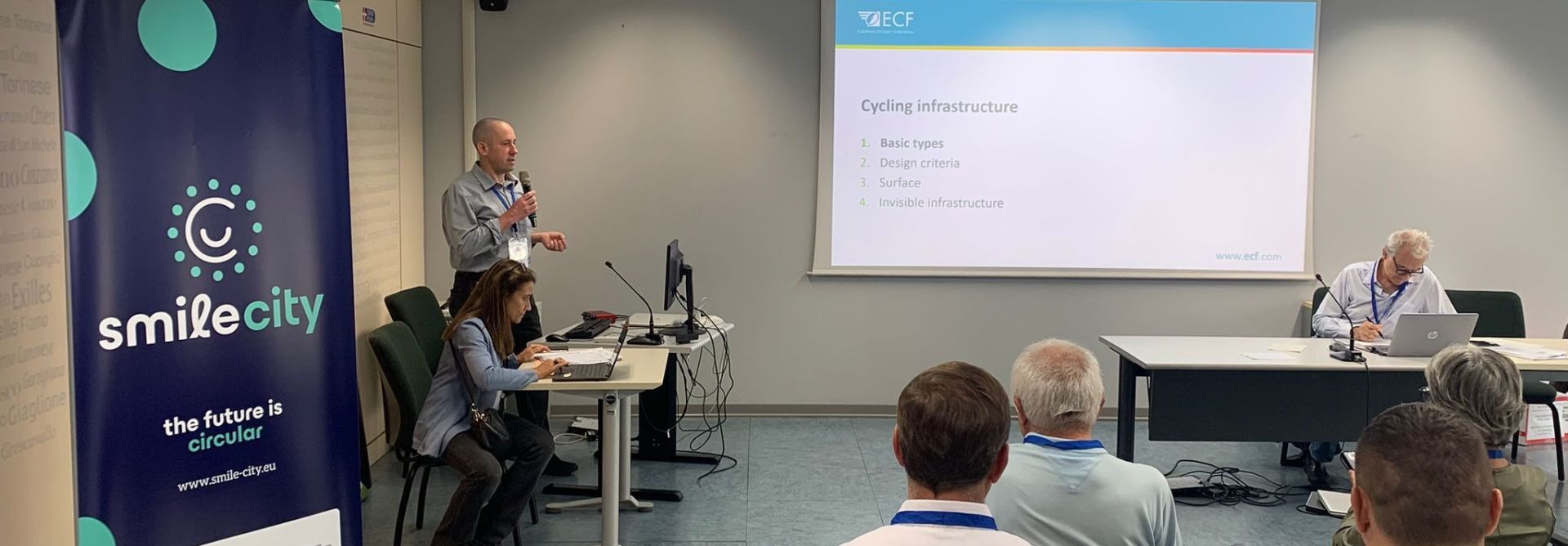
Aleksander Buczynski addresses SMILE CITY project partners and city representatives in Turin.
Beyond the headline figures, Cycling Counts developed shared methodologies and practical recommendations to improve how cycling data is collected and compared across Europe. While fragmentation persists, the project showed growing momentum, with 18 of 27 Member States already working towards national standards or platforms for cycling infrastructure data.
As discussions on the next Multiannual Financial Framework advance, long-term funding for cycling is increasingly at stake. Proposed moves towards centralised National and Regional Partnership Plans could weaken support for locally driven cycling investments. In response, ECF is prioritising this file and expanding its engagement with the European Parliament.
Keeping European Vehicle Safety Standards Non-Negotiable
ECF joined cities and civil society in warning against a worrying clause in a proposed EU–US trade deal, where the EU signalled it “intends to accept” lower US car standards. ECF, alongside nine other organisations, co-signed a letter to the Commission, explicitly objecting to any such regulatory equivalence. Following the August announcement, concerns intensified. By October, cities like Paris, Brussels and Amsterdam — along with 75+ organisations — cautioned that this would let more dangerous, more polluting vehicles enter Europe.
The campaign drew a positive signal from Executive Vice-President Séjourné, who reaffirmed the EU’s regulatory autonomy in response to a question by MEP Wouter Beke, supported by ECF board member Jan Vermeulen. While the trade deal remains a concern, the reply marked a constructive step forward.

In August, cities and civil society organisations urged EU lawmakers not to accept US car standards that would risk European lives.
EU rules have helped cut road deaths by 36% since 2010. In the US, fatalities — including pedestrian and cyclist deaths — have surged to their highest levels in 40 years. Accepting weaker standards would reverse Europe’s progress, worsen air pollution and put manufacturing jobs at risk, all while opening the door to oversized pick-ups and SUVs.
In 2025, walking and cycling featured prominently at COP30 in Belém, reflecting sustained advocacy by ECF, FIA Foundation, Walk 21 and UNEP through the PATH coalition. As a UN-accredited observer, ECF helped ensure active mobility was firmly embedded in discussions on transport decarbonisation, public health and climate finance, including through multiple official side events and contributions to sessions on Nationally Determined Contributions (NDCs).
Ahead of COP30, PATH published a global stocktake analysing 71 NDCs, covering 36% of global emissions, and launched a call to action—now supported by 240+ organisations in 55+ countries—urging governments to make walking and cycling central to climate commitments. PATH also contributed to the COP30 Plan to Accelerate Solutions for Sustainable Urban Mobility, reinforcing the role of active mobility, public transport and rail in raising ambition ahead of the next Global Stocktake.
In 2025, ECF advanced its long-standing work on cycling–rail integration with an updated Cyclists Love Trains report. It confirmed steady progress across Europe, with more bike spaces on long-distance trains, rising bicycle carriages, and new rolling stock increasingly designed for cyclists. This momentum was reinforced by new EU passenger rights rules setting a first legal minimum for bicycle spaces, prompting ECF to assess long-distance rail operators and issue practical recommendations for more cyclist-friendly rail travel.
Crucially, this work fed into ECF’s wider international advocacy. In 2025, railway companies agreed on a common definition of a “regular, assembled bicycle” for cross-border services, removing long-standing barriers for international train travel and cycle tourism.
Ahead of the EU’s Sustainable Tourism Strategy expected in Spring 2026, ECF continued to strengthen recognition of cycling tourism and EuroVelo as key contributors to both tourism and the wider economy.
This advocacy was reinforced in December at the 24th European Tourism Summit in Copenhagen, where ECF championed for “green tourism” to include active mobility. Drawing on insights from our 2025 transnational survey in the Danube Region, we promoted “multimodality by design”: while 75% of cycle tourists used public transport, most reported poor integration.
Building on our input to the 2025 public consultation, ECF is now pushing for concrete commitments, including institutional support for cycling tourism and EuroVelo development, modernisation of the EuroVelo digital ecosystem, and formal recognition of cycling tourism’s role in climate action and the economy through updated data and estimates.
In parallel, ECF worked to translate EU-level guidance into national action. Early in the year, we contributed alongside 15 national authorities to a THE PEP (WHO/UNECE) guide on sustainable tourism mobility, and will next work with National EuroVelo Coordination Centres to embed its recommendations in national transport and tourism strategies.
Highlights from a promotional video for the EuroVelo 8 cycling route through Croatia.
Since September, Laurianne Krid has led the organisation into its next chapter, with 2025 highlighting several important developments across ECF’s advocacy, research, and collaboration efforts.
Partnerships to advance sustainable urban mobility
In 2025, ECF consolidated and extended its cooperation across the European mobility ecosystem, including renewing the partnership with EIT Urban Mobility, which will focus on shared intelligence and data, joint European projects, and practical tools that support active mobility.
Cities and regions remained at the heart of ECF’s work. Through close collaboration with POLIS, ICLEI Europe, Eurocities and Energy Cities, and via ECF’s Cities & Regions for Cyclists network, the organisation ensured that local and regional experience fed directly into EU policy debates. This included joint advocacy on the EU Social Climate Fund, where ECF championed cycling’s inclusion and positioned it as a practical tool to tackle transport poverty within an €87 billion programme for 2026–2032, aligned with EU guidance on safe infrastructure, access to bikes and multimodal links.
In parallel, we advanced discussions to renew our cooperation with UITP, reinforcing the integration of cycling and public transport in planning, funding and implementation—a building block of a people-centred, low-carbon mobility system. This month, the Confederation of the European Bicycle Industry (CONEBI) and Cycling Industries Europe (CIE), announced a successful merger to become European Cycling Industries (ECI). ECF warmly welcomed this merger, which establishes one consolidated voice for the cycling sector to advocate effectively for competitive industrial policy and market development.
Strong ties with ECI leadership and members will allow more synergies in the future. A joint workshop between ECF and ECI members is also planned before our next AGM.
Progress report on the EU Declaration on Cycling and the role of data
The adoption of the European Declaration on Cycling, which recognised cycling as a strategic EU priority, was an El Dorado moment for our sector. It represented the culmination of years of tireless campaigning on the part of ECF and our partners. In October, the European Commission published its first progress report, a check-in on the implementation of the European Declaration on Cycling.
The report confirmed growing momentum, but also the challenge of turning political commitments into delivery. ECF welcomed tangible progress, including €3.21 billion in EU Structural Funds currently invested in cycling projects, alongside concrete local successes, while noting that implementation remains uneven across Member States—a gap ECF will revisit in its updated analysis of National Cycling Strategies in 2026.
ECF proudly brought its know-how to support the Commission in measuring the infrastructure available to cyclists across the EU through the European Commission-commissioned Cycling Counts project. Its preliminary findings were already shared by the EU Commissioner for Transport, Apostolos Tzitzikostas.
Its most tangible achievement was the establishment of the first common EU-wide baseline for cycling infrastructure data, showing that Europe now has more than 340,000 kilometres of dedicated cycling networks. The project assessed the availability and quality of cycling data across all Member States in four key domains: network/infrastructure, usage, safety, and services such as bike sharing, cycle logistics, and bike parking.
Aleksander Buczynski addresses SMILE CITY project partners and city representatives in Turin.
Beyond the headline figures, Cycling Counts developed shared methodologies and practical recommendations to improve how cycling data is collected and compared across Europe. While fragmentation persists, the project showed growing momentum, with 18 of 27 Member States already working towards national standards or platforms for cycling infrastructure data.
As discussions on the next Multiannual Financial Framework advance, long-term funding for cycling is increasingly at stake. Proposed moves towards centralised National and Regional Partnership Plans could weaken support for locally driven cycling investments. In response, ECF is prioritising this file and expanding its engagement with the European Parliament.
Keeping European Vehicle Safety Standards Non-Negotiable
ECF joined cities and civil society in warning against a worrying clause in a proposed EU–US trade deal, where the EU signalled it “intends to accept” lower US car standards. ECF, alongside nine other organisations, co-signed a letter to the Commission, explicitly objecting to any such regulatory equivalence. Following the August announcement, concerns intensified. By October, cities like Paris, Brussels and Amsterdam — along with 75+ organisations — cautioned that this would let more dangerous, more polluting vehicles enter Europe.
The campaign drew a positive signal from Executive Vice-President Séjourné, who reaffirmed the EU’s regulatory autonomy in response to a question by MEP Wouter Beke, supported by ECF board member Jan Vermeulen. While the trade deal remains a concern, the reply marked a constructive step forward.
In August, cities and civil society organisations urged EU lawmakers not to accept US car standards that would risk European lives.
EU rules have helped cut road deaths by 36% since 2010. In the US, fatalities — including pedestrian and cyclist deaths — have surged to their highest levels in 40 years. Accepting weaker standards would reverse Europe’s progress, worsen air pollution and put manufacturing jobs at risk, all while opening the door to oversized pick-ups and SUVs.
Putting active mobility at the heart of global climate commitments
In 2025, walking and cycling featured prominently at COP30 in Belém, reflecting sustained advocacy by ECF, FIA Foundation, Walk 21 and UNEP through the PATH coalition. As a UN-accredited observer, ECF helped ensure active mobility was firmly embedded in discussions on transport decarbonisation, public health and climate finance, including through multiple official side events and contributions to sessions on Nationally Determined Contributions (NDCs).
Ahead of COP30, PATH published a global stocktake analysing 71 NDCs, covering 36% of global emissions, and launched a call to action—now supported by 240+ organisations in 55+ countries—urging governments to make walking and cycling central to climate commitments. PATH also contributed to the COP30 Plan to Accelerate Solutions for Sustainable Urban Mobility, reinforcing the role of active mobility, public transport and rail in raising ambition ahead of the next Global Stocktake.
Cyclists Love Trains: making multimodality work
In 2025, ECF advanced its long-standing work on cycling–rail integration with an updated Cyclists Love Trains report. It confirmed steady progress across Europe, with more bike spaces on long-distance trains, rising bicycle carriages, and new rolling stock increasingly designed for cyclists.
Crucially, this work fed into ECF’s wider international advocacy. In 2025, railway companies agreed on a common definition of a “regular, assembled bicycle” for cross-border services, removing long-standing barriers for international train travel and cycle tourism.
Sustainable Tourism Strategy
Ahead of the EU’s Sustainable Tourism Strategy expected in Spring 2026, ECF continued to strengthen recognition of cycling tourism and EuroVelo as key contributors to both tourism and the wider economy.
This advocacy was reinforced in December at the 24th European Tourism Summit in Copenhagen, where ECF championed for “green tourism” to include active mobility. Drawing on insights from our 2025 transnational survey in the Danube Region, we promoted “multimodality by design”: while 75% of cycle tourists used public transport, most reported poor integration.
Building on our input to the 2025 public consultation, ECF is now pushing for concrete commitments, including institutional support for cycling tourism and EuroVelo development, modernisation of the EuroVelo digital ecosystem, and formal recognition of cycling tourism’s role in climate action and the economy through updated data and estimates.
In parallel, ECF worked to translate EU-level guidance into national action. Early in the year, we contributed alongside 15 national authorities to a THE PEP (WHO/UNECE) guide on sustainable tourism mobility, and will next work with National EuroVelo Coordination Centres to embed its recommendations in national transport and tourism strategies.
Highlights from a promotional video for the EuroVelo 8 cycling route through Croatia.


