As a Cities & Regions for Cyclists (CRC) network member, Zurich is one of the cities with the highest quality of life in the world and the largest in Switzerland with more than 450,000 inhabitants. The city is committed to meeting the population’s needs for urban space and mobility to remain an attractive residential and business location.
We spoke with Nicola Kugelmeier, Project Manager for Transportation Planning at the City of Zurich’s Civil Engineering Office, and Louis Jacob, Project Manager for Bicycle Promotion for the Traffic Management Division, about the role of cycling in achieving Zurich’s mobility goals. As outlined in the city’s overarching Urban Space and Mobility 2040 strategy, cycling has become an important lever for keeping the growing city liveable and moving toward climate neutrality. To turn this vision into action, the City of Zurich is implementing its Cycling Strategy 2030, which focuses on creating a safe, accessible cycling network for all and reflects the city’s evolving approach to sustainable mobility.
“The call we are hearing louder and louder is ‘Keep moving forward!’... For many, progress in promoting cycling is too slow and too limited. That’s why the cycling strategy was further developed in 2019. The Urban Space and Mobility 2040 strategy also incorporates cycling in a revised form. […]
Cycling safely and easily through Zurich – that is the vision of the ‘Cycling Strategy 2030’. Behind this vision, there are three goals the strategy aims to achieve, and which are regularly reviewed on the basis of measurable criteria: the bicycle helps to shape sustainable transport as a whole; safe cycling; and cycling is a matter of course for everyone. Three strategic approaches support these goals: a coherent, safe and visible network; a positive cycling culture; and integral planning.”
Among these strategic goals, safe cycling stands at the forefront of Zurich’s ambitions. Few initiatives illustrate this commitment more clearly than the Stadttunnel. This dedicated cycling tunnel, running beneath the main train station, gave a new purpose to the abandoned tunnel shell built for the “Expressstrassen‑Y” project, where three highways were once planned to converge in the city centre. The City of Zurich later seized the opportunity to repurpose it for soft mobility, and in June 2021, 74% of residents endorsed its conversion. The Stadttunnel now stands as a tangible and decisive step forward for the promotion of cycling in Zurich. Since its opening in May 2025, it has gained popularity. In just 11 months, 1 million trips have already been recorded – a success that finds its roots in people’s need for a safe connection to and around the main station.
“What began around 70 years ago as an idea for a highway through the middle of the city has now been successfully completed as a safe and easy cycle route beneath the main train station. It also offers a bicycle station with 1,240 parking spaces and direct access to the train station. The Stadttunnel brings the two environmentally friendly modes of transport, cycling and public transport, even closer together and contributes to improving the situation for cyclists in general. Away from motorized traffic and toward environmentally friendly cycling, the tunnel also reflects the city's long-term strategies and is an important milestone for the city's promotion of cycling.”

Stadttunnel
Photo Credit: City of Zurich, Eduard Meltzer

Stadttunnel bicycle station
Photo Credit: City of Zurich
The City of Zurich’s determination to make cycling safe and easy for everyone extends beyond major infrastructure projects. The city is constantly implementing smaller and larger measures that deliver significant impact for cyclists across the network. Nicola Kugelmeier and Louis Jacob highlighted one such example:
“A few years ago, at two traffic-light-controlled T-junctions, the bicycle traffic lights for the straight-through direction were switched to flashing yellow. With this measure, cyclists can use this connection at any time. If there is a conflict with pedestrians at the crosswalk, cyclists must give right of way. The positive feedback from the public was remarkably strong.”
As an outcome of this innovative approach, improvements are visible all around the city. Besides flashing yellow lights at two junctions, cyclists are allowed to turn right when the light is red at over 200 traffic lights. Zurich was one of the first Swiss cities to introduce the new signaling at the beginning of 2021. The bike-sharing system "Züri Velo" will also be significantly expanded by summer 2026. Users will be able to rent 2,500 bicycles and e-bikes at 250 stations throughout the city, including the outskirts of it.
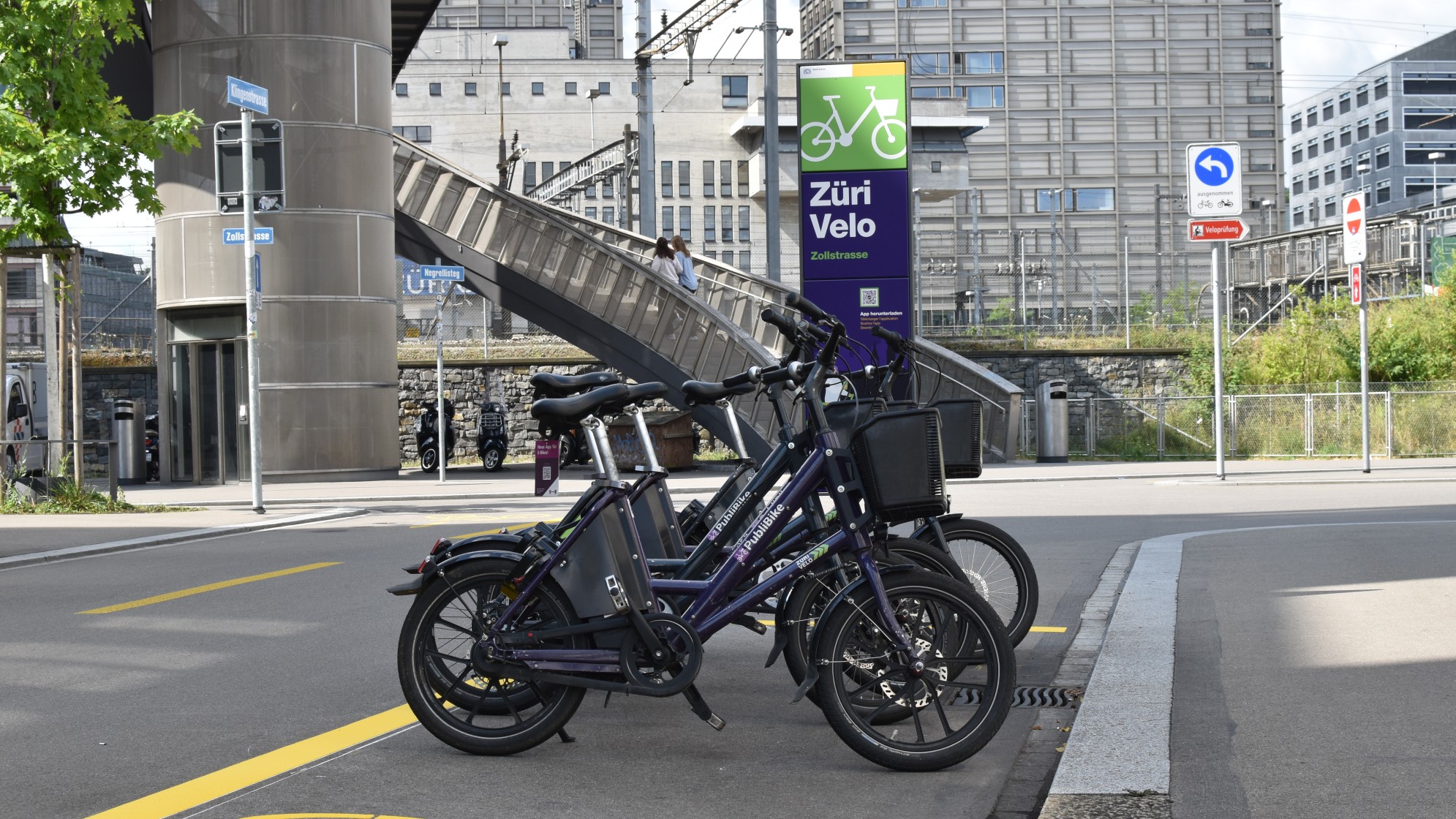
A Züri Velo bike-sharing station
Photo credit: City of Zurich
The City of Zurich’s proactive stance on cycling development is also evident in the way the city has strengthened its internal capacity to consistently deliver improvements across the cycling network. This shift toward more responsive implementation is embodied by the creation of a dedicated unit within the city administration, an initiative that other cities can get inspired by:
“In autumn 2019, the parliament of the City of Zurich allocated a budget of 600,000 Swiss francs for the promotion of cycling. With this budget, new positions were created. Since summer 2020, a four-member ‘Express team’ has set to work within the city administration, to quickly remedy weak points in the cycling network. In addition, a strategic focus on safe cycling has been in place since 2019. In various resulting projects, safety deficits in the city of Zurich are being remedied promptly and efficiently.”
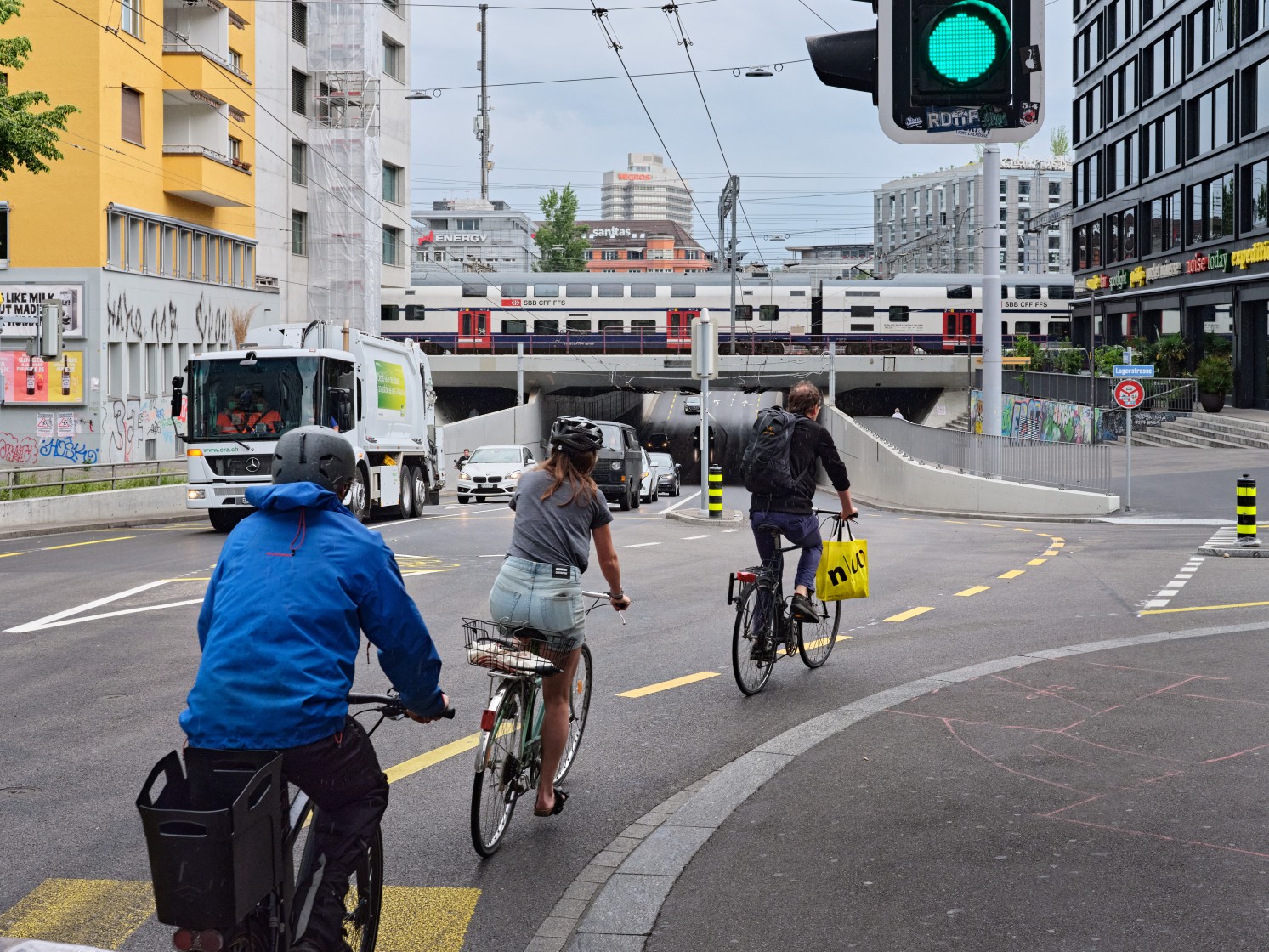
Photo credit: City of Zurich
Despite these significant achievements, the City of Zurich faces some challenges in developing its cycling network. The city aims to build around 130 kilometres of Premium Cycle Routes to create a continuous, safe and visible network for all riders, marked by green stripes and large bike symbols. However, the project is progressing slowly, with only 5,36 kilometres completed so far. Implementation is hindered by the lack of available space, competing transport needs and several legal procedures related to the removal of car parking spaces. Despite these hurdles, the City of Zurich remains committed to its cycling vision.
“There are a lot of objections to the Premium Cycle Routes. These routes are mainly implemented on local roads, where many parking spaces have been removed to create more space. The appeals process for premium cycle routes is complex and challenging. However, it plays a decisive role in determining how long it takes for a Premium Cycle Route to be implemented. Well-prepared documents and patience go a long way.”

Premium Cycle Route
Photo credit: City of Zurich
Zurich’s response to these challenges is an incremental, community‑centred approach that strengthens both the legitimacy and the effectiveness of its cycling strategy. The city works closely with organisations such as Pro Velo Switzerland and actively involves residents and local businesses in shaping long‑term mobility planning. For instance, during the development of the Urban Space and Mobility 2040 strategy, more than 1,200 people contributed through an online survey, while a further 800 participated in neighbourhood‑based activities. Public involvement also extends to funding decisions. While a global credit of 120 million CHF has been allocated for cycling projects over several years, a popular vote took place in November 2025 to increase this amount to 350 million CHF and was accepted by 55% of the population.
Collaboration with other cities is also an important part of the City of Zurich’s efforts, in alignment with the belief that sharing ideas and learning from others is essential for promoting safe and accessible cycling.
“We developed the 2030 Cycling Strategy based on analyses and discussions with in-house experts and external experts from Switzerland and abroad. We are in regular contact with Basel, Bern, Winterthur, and Lucerne. Of course, we also look to Paris and the major successful Nordic cities such as Copenhagen and Amsterdam.”
Building on its progress, the City of Zurich aims to keep the momentum going with determination paired with steady, incremental action. As a final takeaway for cities pursuing their own cycling ambitions, Nicola Kugelmeier and Louis Jacob offer this advice:
“Build partnerships with pedestrian and public transportation groups. Promote the so-called ‘eco-friendly transportation mix.’ Plan small-scale measures to improve the network to complement larger, long-term projects. This makes gradual improvement possible.”
For more information on Cities & Regions for Cyclists, click here.
For more information on the City of Zurich, click here.


