Five years away from the 2030 objective of the pan-European Cycling Master Plan for every country in the region to have developed and implemented a national cycling strategy, we are still a long way off from achieving that target, ECF’s 2025 report on “The state of national cycling strategies in Europe” will reveal. In fact, we are going slightly into the reverse.
In 2025, only one country adopted a national cycling strategy for the first time: Estonia (ECF reported). In doing so it is following in the footsteps of its Baltic sibling, Lithuania, the only country to have a done the same in 2024. The Baltics is currently the most dynamic region when it comes to national cycling policies.
Two other territories that already had a strategic framework but approved a new one are Austria and Wales.
In Belgium, Denmark and England, the development of new updated cycling strategies is underway. Malta and Slovenia are in the process of developing a first national policy framework, Ukraine is firmly committed to doing so.
Overall progress towards the 2030 objective stalls
While we strongly welcome these positive commitments and developments, they are not enough to reach the 2030 objective for every of the 54 member countries in the region to have developed and implemented a national cycling strategy. Even more so as we had do downgrade the status of two countries: Greece and Italy. Greece’s went from “under development” to “none” as any progress in developing a genuine strategy has seemingly come to a standstill. Italy’s national cycling plan expired in 2024. We have no evidence that there is still a credible process in place to continue its implementation. As Velo-city 2026 comes to Rimini, Italy, it is particularly regrettable to see the lack of commitment on the side of its national authorities.
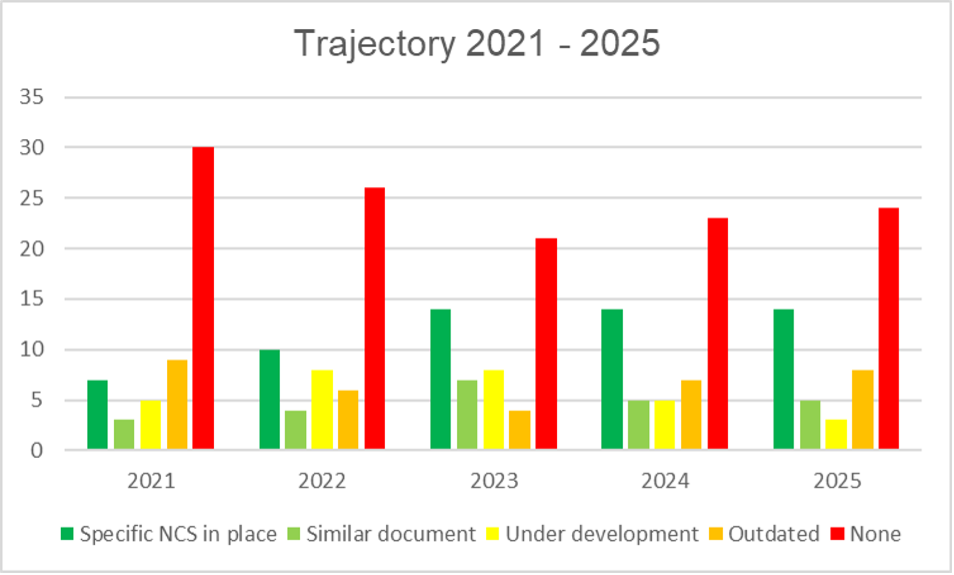
Taking all developments together, this is the 2025 state of play:
- 14 countries have a national cycling strategy (2024: 14)
- Five countries have a strategy similar to a national cycling strategy in place (2024: 5)
- Eight countries used to have a national cycling strategy, but it has expired and needs updating (2024: 7)
- In three countries, a first national cycling strategy is under development (2024: 5)
- In 24 countries, none of the above applies; a national cycling strategy or similar document is neither in place nor under development (2024: 23)
Can Europe find new momentum?
The table above indicates the real momentum between 2021 and 2023 in terms of more countries coming onboard with regards to developing a national cycling policy framework. The number of countries with a national cycling strategy doubled, and more strategies were under way.
In 2024 and 2025 we broadly witness stagnation, despite the adoption of the European Declaration on Cycling in 2024. Under that declaration, under the first core principle “Developing and Strengthening Cycling Policies”, signatories committed to “developing, adopting, and strengthening cycling policies and strategies at all relevant levels of governance.”
All EU member states, and associated countries applying for EU membership, are therefore particularly called upon to (re-)start the process of developing, adopting and implementing a national cycling strategy. Countries in the Caucasus region and in Central Asia should follow suit.
As the Estonian strategy pointed out, every Euro invested in cycling will generate benefits to the tune of 4 to 8 Euro. This is not exactly a new finding, but it’s worth repeating the message. Investing in cycling makes socio-economic sense. The majority of countries in the pan-European region still need to hear that message.
Read our latest report on The state of national cycling strategies in Europe


