Launched in April 2025 by the Cities for Better Health initiative (Novo Nordisk) together with ECF, the Healthy Cycling Challenge called for innovative and ready-to-implement proposals that leverage cycling as an active mode of transport, and as a tool for promoting public health, environmental sustainability and social equity in urban neighbourhoods. Three winners were awarded 100,000 USD each to implement their projects:
- Pedalando Juntas by Instituto Caminhabilidade in Brazil develops community bike-sharing systems in favelas.
- Pedalea Seguro by the Peruvian Society for Environmental Law in Peru strengthens urban cycling for healthier and more inclusive cities.
- Pedal Paathshala by Cycle City Network Nepal in Nepal creates community learning opportunities on wheels.
Eight months after their official presentation, the Healthy Cycling Challenge winners showcased how their project has moved into implementation during the session “Promoting healthy and sustainable urban neighbourhoods in Peru, Nepal and Brazil,” at Velo-city 2026 Rimini.
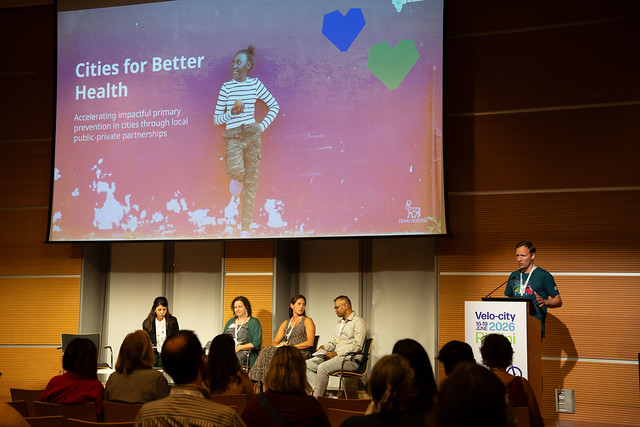
Healthy Cycling Challenge winners during the session “Promoting healthy and sustainable urban neighbourhoods in Peru, Nepal and Brazil,” at Velo-city 2026 Rimini
Pedalando Juntas: Community bike-sharing systems in favelas – Instituto Caminhabilidade, Brazil
Instituto Caminhabilidade is a Brazilian women-led, non-profit organisation founded in 2012. Driven by the urgency of achieving gender equality while addressing the climate crisis, its focus is on developing walkable cities with citizens, creating bridges between civil society, governments and other stakeholders.
With the support of the Healthy Cycling Challenge, Instituto Caminhabilidade implements Pedalando Juntas, a community bike-sharing system operating in the neighbourhoods of Jardim Panorama and Jardim Ibirapuera in São Paulo. Unlike conventional bike-sharing systems, the programme is run by the communities themselves. Each neighbourhood has a fleet of 10 bicycles that residents can borrow for a limited period, making cycling more accessible while encouraging greater use of public spaces and nearby parks, particularly by women and children.

Pedalando Juntas shared bicycles
Photo Credit: Instituto Caminhabilidade
The project was rolled out in 2026 through a participatory process combining research and community engagement. As a first step, the Instituto Caminhabilidade team carried out site visits to familiarise itself with the areas, learn about cycling habits and introduce the project to the community. Baseline surveys highlighted significant barriers to cycling and confirmed that the absence of bicycles, rather than a lack of interest in public spaces, was a key obstacle to active mobility in both neighbourhoods.
With the help of local coordinators, the team organised participatory workshops for residents to co-design the bike-sharing system. Dialogue with the communities is central to the project’s methodology and key to tailoring it to the specific characteristics of each area.

Participatory workshop with residents of Jardim Panorama
Photo Credit: Instituto Caminhabilidade, LinkedIn
The first weeks of operation demonstrated strong community interest, with dozens of residents registering to use the system and women representing more than half of participants in both neighbourhoods. The largest group of users was children and young people aged 0–17, reflecting the project's potential to foster new cycling habits from an early age while expanding access to safe and affordable mobility.
Looking ahead, the project seeks to increase women's participation while addressing practical challenges such as bicycle maintenance, lending infrastructure and the long-term sustainability needed to expand the model to other communities.
Pedalea Seguro: Urban Cycling for Healthier and More Inclusive Cities – Peruvian Society for Environmental Law, Peru
Implemented by the Peruvian Society for Environmental Law, Pedalea Seguro is an initiative launched in 2024 to promote urban cycling in Peru through data collection, tactical urbanism and legal analysis. The project puts a strong focus on community engagement and works closely with local cycling groups to identify barriers to everyday cycling and translate local knowledge into practical solutions. With the support of the Healthy Cycling Challenge, Pedalea Seguro is being implemented across three pilot cities: the capital city Lima, and the two intermediate cities of Tacna and Trujillo.
The initiative combines several complementary areas of work including developing digital territorial planning tools in partnership with local governments, testing tactical urbanism interventions, analysing sustainable mobility policies and strengthening the capacity of local cycling organisations. Currently, territorial planning dashboards have already been developed for Lima and Trujillo, with a third underway for Tacna, while a technical and legal assessment of Lima's cycling infrastructure is identifying opportunities to improve safety and connectivity. At the same time, Pedalea Seguro promotes tactical urbanism interventions with more than 300 m² of cyclist-themed murals, seven community bike rides, and training and legal support for local cycling groups.


Tactical urbanism interventions with local cyclists in Trujillo and Tacna
Photo Credit: Peruvian Society for Environmental Law
This approach is already strengthening local engagement. In Tacna, the project was launched last April with a children's cycling school, awareness-raising activities and a community mural, bringing together residents, local authorities and cycling groups around a shared vision for safer streets. In Trujillo, World Bicycle Day celebrations brought together more than 200 participants who took to the streets to call for safer and more welcoming cities for urban cycling.
By implementing Pedalea Seguro not only in Lima but also in intermediate cities such as Trujillo and Tacna, the project is showing that sustainable mobility should be pursued across diverse urban contexts. With 2026 being an election year in Peru, Pedalea Seguro provides timely evidence to support stronger national policies that place urban cycling at the centre of healthier and safer cities.
Pedal Paathshala: Community Learning on Wheels – Cycle City Network Nepal, Nepal
Pedal Paathshala is a community-based initiative launched by Cycle City Network Nepal that combines cycling education for women, teachers and students from the city of Bharatpur. The project aims to equip them with the skills and confidence to make cycling part of everyday life. To achieve this, Cycle City Network Nepal has already established partnerships with various actors such as Bharatpur Metropolitan City and the Chitwan Cycle Riders Club, creating a collaborative framework that brings together local government, civil society and technical experts.
With the support of the Healthy Cycling Challenge, Cycle City Network Nepal has been able to implement a key component of Pedal Paathshala: the creation of a bicycle library. One hundred bicycles and toolkits have been distributed across 10 schools to give students access not only to cycling, but also to safety equipment, maintenance tools and digital learning resources.
Building local capacity has been another major focus. Last May, the project launched a seven-day “Training of Trainers” programme that brought together 20 women and 10 school teachers. After completing 50 hours of training and two weeks of community engagement, participants graduated on World Bicycle Day and are now equipped to establish and mentor school cycling clubs, taking cycling advocacy to the grassroots level.

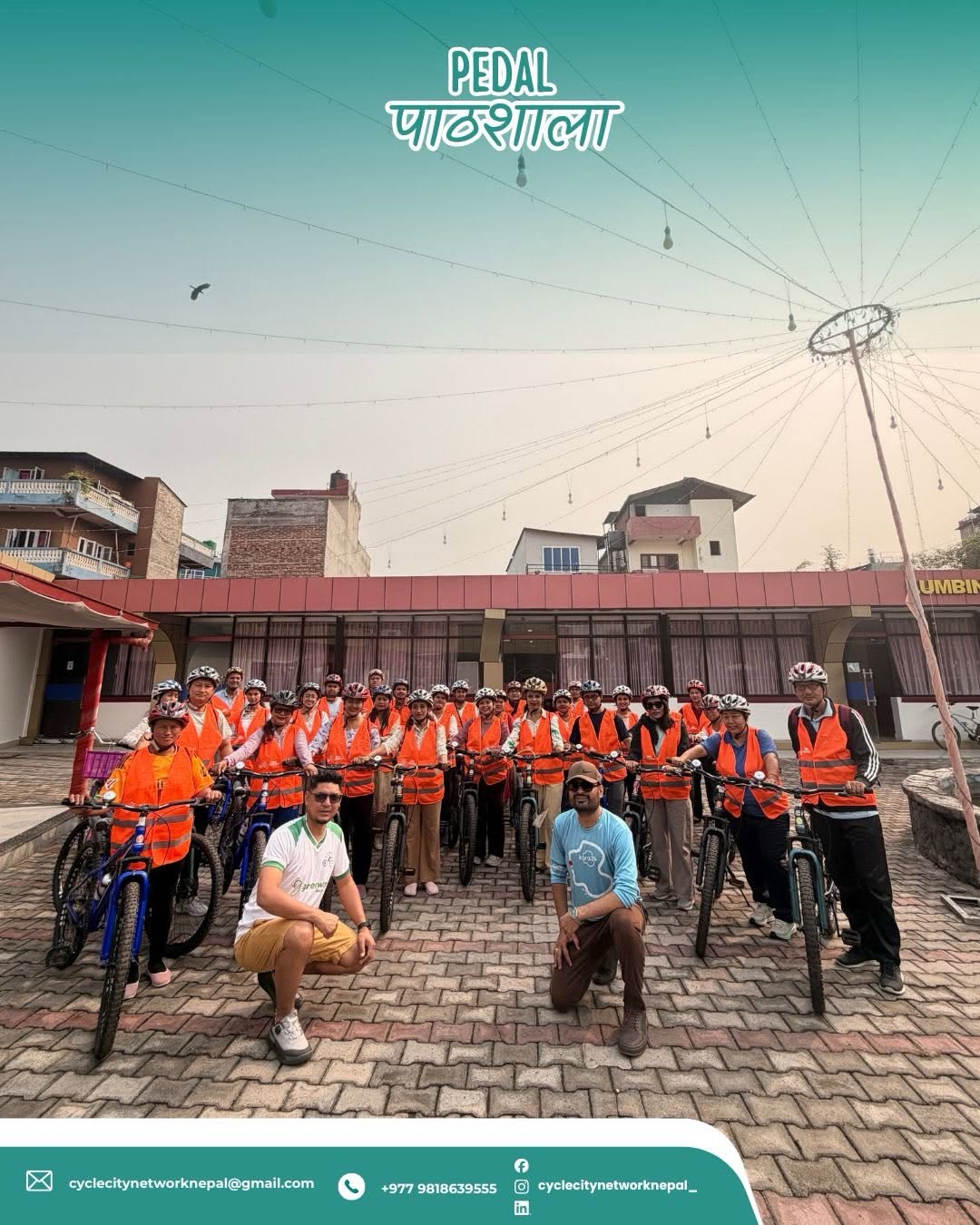
Pedal Paathshala’s Training of Trainers
Photo Credit: Cycle City Network Nepal, Facebook
Beyond the classroom, Pedal Paathshala is creating opportunities for the wider community to embrace cycling. Among others, group rides, focus group discussions, critical mass events involving more than 500 participants, and World Bicycle Day celebrations featuring a mural art competition have helped raise the profile of cycling while encouraging people of all ages to see the bicycle as a practical means of transport and social connection. By embedding cycling education within schools and empowering local trainers to lead the programme, the project is laying the foundations for a new generation of confident cyclists in Nepal and demonstrating how community-based learning can support healthier, more sustainable cities.

Group ride for World Bicycle Day 2026
Photo Credit: Cycle City Network Nepal, Facebook
Together, the Healthy Cycling Challenge winners demonstrate that meaningful change begins within neighbourhoods. Their early results highlight both the diversity of approaches and the shared commitment to creating cities where cycling is part of a healthier future for all. With strong foundations now in place, the coming months offer promising opportunities for each project to deepen its impact and further strengthen everyday cycling in their communities.
Learn more about Cities for Better Health here.
More information on Pedalando Juntas on Instituto Caminhabilidade’s website.
More information on Pedalea Seguro on the dedicated website.
More information on Pedal Paathshala on Cycle City Network Nepal’s website.


